











Trading Fees
0.015% maker / 0.045% taker (0 L1 gas)
Tradable Markets
150+ Perps & Native Spot
Deposits & Access
Arbitrum USDC · No Mandatory KYC
Coinweb Aggregate Rating
Weighted aggregate score across 6 hands-on DEX evaluation benchmarks
Sub-second HyperBFT finality, 200k+ orders/sec, and deepest on-chain perp books
0.015% maker / 0.045% taker base perps, $0 L1 gas, up to 40% HYPE staking discount
CEX-speed web terminal, HLP & user vaults, sub-accounts, TWAP, and scale orders
150+ perpetual pairs (up to 40x–50x), HIP-1/HIP-2 spot, and HIP-3 custom markets
Self-custodial trading + hardened risk caps post-March 2025 JELLY stress test; bridge risk remains
Zero-VC community fee burn & HYPE staking, though validator set is still maturing
Coinweb Quick Verdict
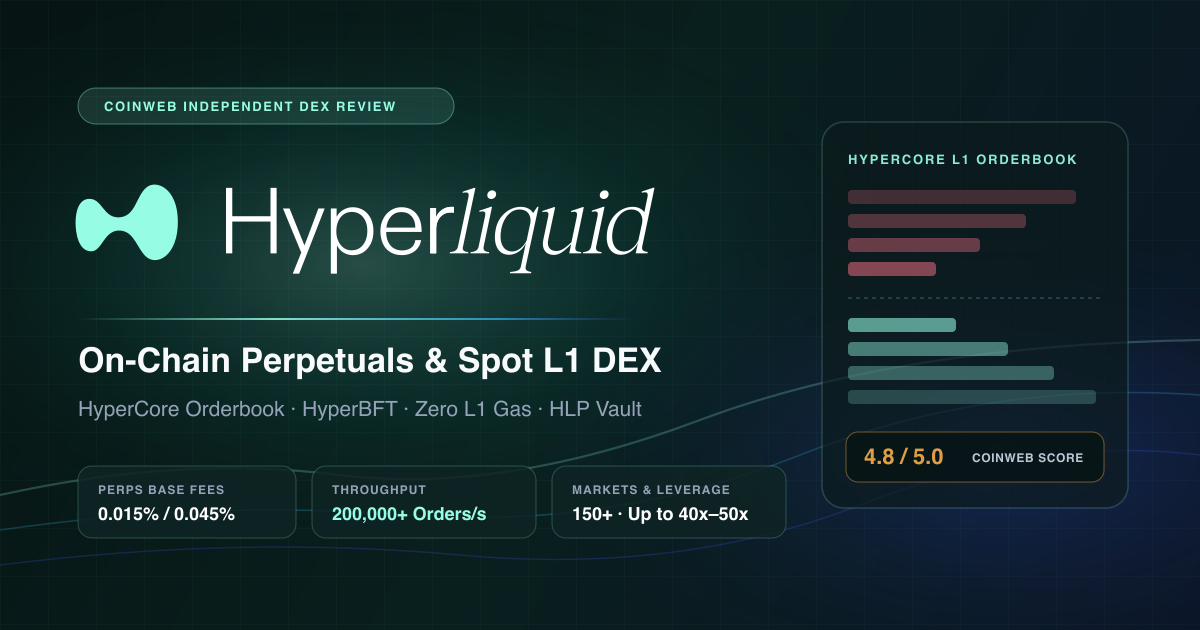
Hyperliquid is the fastest on-chain perpetuals and spot decentralized exchange in crypto, running a fully on-chain central limit order book (HyperCore) on its own custom Layer-1 blockchain (HyperBFT) at 200,000+ orders per second with zero L1 gas fees, base perp fees of 0.015% maker / 0.045% taker, up to 40% HYPE staking fee discounts, and non-custodial wallet trading.
Editorial & Affiliate Disclosure: Outbound “Visit” links may earn Coinweb.com a partner commission at no extra cost to you. Our scores follow our independent testing methodology.
Pros
- Fully on-chain central limit order book (HyperCore) with sub-second HyperBFT finality and 200,000+ orders/sec throughput
- Zero gas fees on L1 order placement, cancellations, and perpetual trades with CEX-grade one-click execution
- Highly competitive base perp fees (0.015% maker / 0.045% taker) plus up to 40% multiplicative HYPE staking discounts and maker rebates up to -0.003%
- 150+ perpetual markets (up to 40x–50x leverage), native HIP-1/HIP-2 spot markets, and permissionless HIP-3 builder-deployed markets
- Protocol-owned HLP vault lets everyday users earn transparent market-making and liquidation yield with zero management fees
- Protocol fees flow directly into community HLP rewards and automated Assistance Fund HYPE buybacks & burns rather than VC insiders
- Non-custodial wallet connection with no mandatory KYC, plus pro tools including TWAP, scale orders, sub-accounts, and low-latency APIs
Cons
- No native fiat on-ramp or off-ramp — accounts must be funded via crypto (primarily USDC bridged from Arbitrum)
- Frontend geo-blocks U.S., Ontario (Canada), and sanctioned jurisdictions
- Smaller active validator set than Ethereum, and emergency validator intervention during the March 2025 JELLY incident highlighted centralization trade-offs
- Arbitrum USDC bridge introduces cross-chain bridge smart-contract risk compared to single-chain Ethereum DEXs
Top dex Alternatives
Compare all Best Decentralized Exchanges (DEXs) 4.8/5
Uniswap is a user-friendly cryptocurrency exchange with competitive fees for all trading levels. It enables direct crypto trading from digital wallets, supports options and futures contracts for BTC and ETH, and offers advanced trading features for experienced traders and institu


Hyperliquid has fundamentally reshaped what traders expect from a decentralized exchange. Rather than squeezing an Automated Market Maker (AMM) or off-chain matching engine onto a congested Ethereum rollup, Hyperliquid built a purpose-designed Layer-1 blockchain from scratch specifically for high-frequency, fully on-chain order book trading. The result is a non-custodial derivatives and spot venue that rivals tier-one centralized exchanges like Binance and Bybit on execution latency and spread depth while keeping every order, cancellation, trade, and liquidation verifiable on-chain.
In this independent Hyperliquid review, our analysts break down Hyperliquid's three-layer technical architecture (HyperBFT, HyperCore, and HyperEVM), verified perpetual and spot fee schedules, HYPE staking discounts, HLP market-making vault economics, the March 2025 JELLY risk-management stress test, and how Hyperliquid compares against Uniswap, PancakeSwap, and centralized exchanges.
Hyperliquid at a Glance: Key Specifications
| Feature | Hyperliquid Specification |
|---|---|
| Platform Type | Decentralized Perpetual & Spot Order-Book Exchange (Custom Layer-1) |
| Founded / Team | 2023 · Hyperliquid Labs (Co-founded by Jeff Yan, ex-Hudson River Trading) |
| Consensus & Engine | HyperBFT Consensus + HyperCore On-Chain CLOB + HyperEVM |
| Throughput & Finality | 200,000+ orders/second · Sub-second single-block finality |
| Supported Markets | 150+ Perpetual Futures + Native HIP-1 Spot + HIP-3 Builder Perps |
| Maximum Leverage | Up to 40x–50x (varies by asset liquidity tier) |
| Base Perps Fees (Tier 0) | 0.015% Maker / 0.045% Taker (Zero L1 gas fees) |
| Base Spot Fees (Tier 0) | 0.040% Maker / 0.070% Taker (Spot counts 2x toward fee tiers) |
| Staking Fee Discounts | 5% to 40% off trading fees by staking HYPE (Wood to Diamond tiers) |
| Deposits & Custody | Self-custodial Web3 wallet · USDC via Arbitrum bridge (no fiat on-ramp) |
| KYC Requirements | No mandatory KYC · Frontend geo-blocking applies |
| Restricted Jurisdictions | United States, Ontario (Canada), and OFAC-sanctioned regions |
| Official Trading Interface | app.hyperliquid.xyz/trade |
What Is Hyperliquid and How Does Its Layer-1 Architecture Work?
Most decentralized exchanges face an uncomfortable trade-off: AMM-based DEXs like Uniswap offer strong composability but suffer from impermanent loss, gas overhead, and slower execution for active derivatives traders, while hybrid order-book DEXs often rely on centralized off-chain sequencers to match trades before settling on-chain. Hyperliquid eliminates that compromise through vertical integration across three core components:
1. HyperBFT Consensus
Hyperliquid runs on HyperBFT, a custom proof-of-stake consensus algorithm inspired by HotStuff and engineered specifically for ultra-low-latency trading state transitions. HyperBFT delivers single-block, sub-second finality so limit orders, market fills, stop-losses, and margin updates confirm almost instantaneously across the validator set without multi-block reorg uncertainty.
2. HyperCore (Fully On-Chain Order Book)
HyperCore is the native financial state machine embedded directly inside the Hyperliquid L1. Unlike smart-contract DEXs competing for block space with NFT mints or memecoin swaps, HyperCore executes matching, margin accounting, funding-rate updates, and liquidations natively in protocol state at upwards of 200,000 orders per second. Crucially, order placements, edits, and cancellations on HyperCore incur zero L1 gas fees (new accounts pay only a one-time 1 USDC activation fee upon initial state creation).
3. HyperEVM (General-Purpose Smart Contracts)
Running alongside HyperCore under the same HyperBFT consensus is HyperEVM—an Ethereum-compatible virtual machine where developers deploy permissionless smart contracts, lending markets, liquid staking wrappers, and structured DeFi apps. Unlike HyperCore's gasless order book, smart-contract execution on HyperEVM pays network gas denominated in HYPE, giving third-party DeFi protocols direct atomic access to HyperCore's deep native liquidity.
Bootstrapped, Zero-VC Origins
Hyperliquid Labs was co-founded by Jeff Yan—a Harvard mathematics and computer science graduate, former low-latency engineer at Hudson River Trading, and founder of crypto market maker Chameleon Trading. Launching after the FTX collapse exposed the dangers of opaque centralized custody, Yan self-funded development without taking venture capital investment. When Hyperliquid launched its native HYPE token in late 2024, it distributed the vast majority of initial supply directly to real traders and community contributors rather than private VC unlock schedules—cementing unusually strong trader loyalty.
Trading Experience: Perpetuals, Spot, and Pro Execution Tools
Connecting a wallet at app.hyperliquid.xyz/trade immediately reveals why active derivatives traders have migrated to Hyperliquid in droves. Once you sign a one-time session approval ("Enable Trading"), every subsequent order executes with single-click responsiveness and zero MetaMask pop-up friction.
Perpetual Futures Markets
Hyperliquid lists over 150 perpetual contracts spanning blue-chip assets (BTC, ETH, SOL, HYPE), trending mid-cap altcoins, and pre-launch markets for anticipated token launches. Leverage scales up to 40x–50x on major high-liquidity contracts and steps down conservatively on smaller-cap pairs to contain systemic risk. Traders can switch seamlessly between Cross Margin and Isolated Margin per position, monitor transparent hourly funding rates, and set resting Take-Profit / Stop-Loss brackets directly on the chart.
Native Spot & the HIP-1 / HIP-2 / HIP-3 Standard
Beyond perpetuals, Hyperliquid operates a fast native spot order book governed by Hyperliquid Improvement Proposals (HIPs):
- HIP-1 (Native Token Standard): Allows teams to deploy fungible L1 spot tokens with native on-chain order books via a transparent Dutch auction for ticker deployment slots.
- HIP-2 ("Hyperliquidity"): An embedded, fully automated on-chain market-making strategy built directly into L1 block execution that bootstraps continuous spot liquidity for HIP-1 tokens without requiring external market-making retainers.
- HIP-3 (Builder-Deployed Perpetuals): Launched in late 2025, HIP-3 enables qualifying external builders who stake and lock at least 500,000 HYPE (subject to a 183-day lock and slashing penalties for risk mismanagement) to deploy custom perpetual markets on HyperCore—unlocking on-chain perpetual exposure to tokenized equities, commodities, and index benchmarks alongside crypto assets.
Advanced Order Types & Institutional APIs
Power users and quantitative desks get native support for Limit, Market, Stop-Limit, Stop-Market, Post-Only (ALO), Reduce-Only, Scale Orders (laddering multiple limit orders across a price band), and TWAP (Time-Weighted Average Price) execution natively enforced on-chain. Hyperliquid also provides sub-accounts (whose volume rolls up into the master account's fee tier) and low-latency REST and WebSocket APIs with official Python and Rust SDKs.
Hyperliquid Fees Breakdown: Perps, Spot & HYPE Staking Discounts
Hyperliquid's fee model is one of the most competitive in both DeFi and CeFi. Tiers are recalculated daily at UTC midnight based on your rolling 14-day weighted volume using the formula: 14d Weighted Volume = (14d Perps Volume) + 2 × (14d Spot Volume)—meaning spot trading counts double toward unlocking lower perpetual fees.
Perpetual Futures Base Fee Tiers
| Volume Tier | 14-Day Weighted Volume | Base Taker Fee | Base Maker Fee | Diamond Staking Taker (-40%) |
|---|---|---|---|---|
| Tier 0 (Base) | < $5,000,000 | 0.045% | 0.015% | 0.0270% |
| Tier 1 | > $5,000,000 | 0.040% | 0.012% | 0.0240% |
| Tier 2 | > $25,000,000 | 0.035% | 0.008% | 0.0210% |
| Tier 3 | > $100,000,000 | 0.030% | 0.004% | 0.0180% |
| Tier 4 | > $500,000,000 | 0.028% | 0.000% | 0.0168% |
| Tier 5 | > $2,000,000,000 | 0.026% | 0.000% | 0.0156% |
| Tier 6 | > $7,000,000,000 | 0.024% | 0.000% | 0.0144% |
Spot Fee Schedule & Stable-Pair Discounts
Spot markets start at 0.070% taker / 0.040% maker at Tier 0 and step down to 0.025% taker / 0.000% maker at Tier 6. Trading pairs between two spot quote assets (such as stablecoin pairs) benefit from an 80% reduction in taker fees, while aligned quote assets earn an additional 20% taker reduction and 50% stronger maker rebates.
HYPE Staking Fee Discount Tiers
Staking native HYPE applies a multiplicative fee discount on top of your volume tier (note that staked HYPE carries a 7-day unbonding period, and you can permanently link a dedicated staking wallet to a separate trading wallet):
| Staking Tier | HYPE Staked | Trading Fee Discount |
|---|---|---|
| Wood | > 10 HYPE | 5% off |
| Bronze | > 100 HYPE | 10% off |
| Silver | > 1,000 HYPE | 15% off |
| Gold | > 10,000 HYPE | 20% off |
| Platinum | > 100,000 HYPE | 30% off |
| Diamond | > 500,000 HYPE | 40% off |
Maker Rebates & Community Fee Alignment
High-volume liquidity providers accounting for more than 0.5%, 1.5%, or 3.0% of 14-day weighted maker volume earn continuous negative maker fees (rebates) of -0.001%, -0.002%, and -0.003% paid trade-by-trade directly to their trading wallet. Even more notably, Hyperliquid directs protocol trading fees to the community—specifically the HLP vault, asset deployers, and the automated Assistance Fund (0xfefefefefefefefefefefefefefefefefefefefe), which programmatically buys HYPE on the open market and permanently burns it from circulating and total supply.
Non-Trading Costs to Keep in Mind
- Account Activation: Brand-new addresses pay a one-time 1 USDC activation fee to initialize L1 state.
- Bridge Gas: While HyperCore trading is gasless, depositing USDC from Arbitrum requires standard Arbitrum ETH gas (typically fractions of a dollar).
- Third-Party Builder Fees: If you route trades through third-party mobile apps, Telegram bots, or custom frontends instead of the official web app, those builders may attach an opt-in Builder Fee (capped at up to 0.1% on perps and 1% on spot).
HLP Vault and Community Copy-Trading Vaults
One of Hyperliquid's standout innovations is democratizing institutional market-making yields through native protocol vaults:
- Hyperliquidity Provider (HLP) Vault: HLP is the protocol's flagship community-owned liquidity and liquidation backstop vault. Anyone can deposit USDC into HLP with 0% management or performance fees (subject to a 4-day lockup window after deposit) to share proportionally in market-making spreads and liquidation capture across the exchange. While HLP is not risk-free and can experience short-term drawdowns during extreme one-sided volatility, its long-term PnL record has made it one of DeFi's most closely watched real-yield venues.
- User-Created Vaults: Experienced traders can open public strategy vaults on HyperCore. Vault leaders must maintain personal skin in the game (at least 5% of total vault equity) and earn a 10% profit share on depositor gains. Every position, entry price, and drawdown curve is auditable in real time on-chain, eliminating the opaque "fake PnL screenshot" problem common on centralized copy-trading platforms.
Is Hyperliquid Safe? Security, Self-Custody & the March 2025 JELLY Stress Test
Evaluating security on a custom L1 DEX requires looking honestly at both its strengths and its real-world stress tests.
Self-Custody & Bridge Architecture
Hyperliquid never holds your private keys. Traders interact directly through hardware wallets (Ledger, Trezor) or browser wallets (Rabby, MetaMask), signing EIP-712 messages to authorize trades and withdrawals. However, because Hyperliquid operates as a sovereign Layer-1 rather than an Ethereum rollup, native USDC deposits pass through the Arbitrum–Hyperliquid bridge contract secured by Hyperliquid's validator quorum. While the bridge has been audited and has processed tens of billions in cumulative flows without an exploit, cross-chain bridge architecture inherently carries a broader trust surface than a single-chain Ethereum smart-contract DEX.
The March 2025 JELLY Incident & Structural Risk Hardening
Hyperliquid's defining risk-management test occurred on March 26, 2025, involving the thinly traded memecoin perpetual JELLY. An attacker opened a large short position on JELLY perpetuals, intentionally triggered self-liquidation so the distressed short position transferred into the HLP backstop vault, and simultaneously drove up JELLY's spot price on thin external venues—briefly pushing HLP's unrealized deficit into multi-million-dollar territory.
To protect depositor solvency and neutralize the manipulation attempt, Hyperliquid validators coordinated an emergency governance action to delist the JELLY perpetual contract and settle open positions at a pre-manipulation reference price, fully preserving protocol solvency. The episode sparked legitimate industry debate around how quickly a relatively compact validator set can intervene during an on-chain crisis. To Hyperliquid's credit, the protocol responded by hardening its risk engine—tightening open-interest caps, refining isolated margin parameters for low-liquidity micro-caps, and introducing stricter backstop guardrails so isolated memecoin manipulation cannot threaten core liquidity pools.
Coinweb Security Verdict: For active traders, Hyperliquid offers dramatically stronger transparency and custody guarantees than centralized exchanges (zero commingled off-chain user funds), while still carrying custom-L1 validator and bridge risk. Treat it as a high-performance active trading venue—keep trading margin on HyperCore and store long-term cold reserves in a dedicated hardware crypto wallet.
Hyperliquid vs. Uniswap, PancakeSwap, and Centralized Exchanges
How does Hyperliquid stack up against leading active decentralized and centralized trading venues? Compare the core trade-offs below (or explore our full Best Decentralized Exchanges comparison):
| Metric | Hyperliquid | Uniswap | PancakeSwap | Tier-1 CEXs (Binance / OKX) |
|---|---|---|---|---|
| Architecture | Custom L1 (HyperCore CLOB + HyperEVM) | Multi-chain AMM Pools | Multi-chain AMM + Perps Router | Centralized Off-Chain Matching |
| Base Trading Fees | 0.015% Maker / 0.045% Taker (Perps) | 0.01%–1.00% LP Pool Fee + Gas | 0.01%–1.00% v3 Pool Fee + Gas | ~0.02% Maker / 0.05% Taker |
| Orderbook Gas | $0 (Zero L1 gas) | Network gas per swap | Low L2 / BNB Chain gas | $0 |
| Custody & KYC | Self-custody · No mandatory KYC | Self-custody · No KYC | Self-custody · No KYC | Custodial · Mandatory KYC |
| Native Yield Vaults | HLP Vault (0% fee) + User Vaults | Concentrated LP Positions | Yield Farms & Liquidity Pools | Custodial Earn / Copy-Trading |
| Best For | High-speed on-chain perps, spot & API traders | Long-tail ERC-20 & L2 token swaps | Low-gas BNB Chain & EVM spot swaps | Fiat on-ramps & regulated spot access |
How to Get Started on Hyperliquid (Step-by-Step)
- Prepare a Self-Custodial Wallet with Arbitrum USDC: Fund an EVM wallet such as Rabby, MetaMask, or a Ledger hardware wallet with native USDC on Arbitrum plus a small amount of Arbitrum ETH ($2–$5 is plenty) to cover the bridge deposit transaction.
- Connect to the Official Interface: Navigate to app.hyperliquid.xyz/trade (always bookmark the exact URL to avoid phishing lookalikes) and click Connect.
- Deposit USDC to HyperCore: Click Deposit, enter your USDC amount on Arbitrum, and confirm the bridge transaction in your wallet. Deposits typically credit to your Hyperliquid margin balance within under a minute.
- Enable One-Click Trading: Sign the gasless EIP-712 session key prompt so order placements and cancellations execute instantaneously without repeated wallet confirmations.
- Configure Margin Mode & Trade: Select a perpetual or spot market, choose Isolated or Cross margin, set conservative leverage, and place a Limit, Market, TWAP, or Scale order—or visit the Vaults tab to evaluate HLP.
Who Should (and Shouldn't) Use Hyperliquid?
Hyperliquid is ideal for: Active crypto perpetual traders who want Binance-grade order-book depth and sub-second fills without surrendering custody; algorithmic and API traders seeking zero-gas order updates and maker rebates; and DeFi users looking for transparent, real-yield liquidity vaults like HLP.
Hyperliquid is NOT ideal for: Complete crypto beginners who need to buy their first Bitcoin directly with a credit card or bank transfer (consider a top fiat-friendly venue in our Best Crypto Exchanges guide instead), or traders residing in restricted jurisdictions such as the United States and Ontario.
Final Verdict: Why Hyperliquid Earns 4.8 / 5.0
Hyperliquid has earned its position as the gold standard for on-chain derivatives infrastructure. By engineering HyperBFT, HyperCore, and HyperEVM as a single vertically integrated Layer-1, it delivers an execution experience that genuinely matches centralized exchanges—paired with lower base fees, gasless order management, HYPE staking discounts up to 40%, and community-aligned tokenomics. While the lack of fiat on-ramps, U.S. geo-restrictions, and a still-maturing validator set keep it shy of a perfect 5.0, an aggregate rating of 4.8 out of 5.0 reflects Hyperliquid's clear leadership among decentralized exchanges.
Frequently Asked Questions
Is Hyperliquid a centralized or decentralized exchange?
Hyperliquid is a non-custodial decentralized exchange running on its own custom Layer-1 proof-of-stake blockchain. All order matching, margin accounting, funding payments, and liquidations happen transparently on-chain via HyperCore, and users retain full control of their private keys rather than depositing into an opaque company bank account.
Does Hyperliquid require KYC?
No. Hyperliquid does not require identity verification (KYC) to connect a self-custodial Web3 wallet and trade perpetuals or spot markets. However, the official web frontend enforces geographic IP restrictions and Terms of Service exclusions for prohibited jurisdictions including the United States, Ontario (Canada), and sanctioned regions.
What are Hyperliquid's trading fees?
At Tier 0 (under $5M in 14-day weighted volume), Hyperliquid charges 0.015% maker and 0.045% taker fees on perpetual contracts, and 0.040% maker and 0.070% taker fees on spot trades, with zero L1 gas fees for orders or cancellations. Staking HYPE unlocks multiplicative fee discounts from 5% (Wood, >10 HYPE) up to 40% (Diamond, >500,000 HYPE), and high-volume makers can earn rebates up to -0.003%.
What is the maximum leverage on Hyperliquid?
Hyperliquid offers up to 40x–50x leverage on flagship high-liquidity perpetual contracts like BTC and ETH, with lower maximum leverage caps on mid-cap and smaller-cap altcoins to protect the protocol against thin-book liquidation cascades.
How do I deposit money onto Hyperliquid?
Hyperliquid does not support direct fiat deposits via bank cards or wire transfers. To fund your trading account, connect an EVM wallet holding USDC on Arbitrum (plus a small amount of Arbitrum ETH for gas) and bridge USDC directly through the official Hyperliquid deposit interface.
Is Hyperliquid safe after the March 2025 JELLY incident?
Hyperliquid preserved full protocol solvency during the March 2025 JELLY manipulation stress test and subsequently tightened open-interest caps, isolated margin limits, and HLP backstop risk parameters for low-liquidity tokens. While self-custody removes FTX-style counterparty fraud risk, users should still account for custom-L1 validator governance and Arbitrum bridge smart-contract risks and avoid storing long-term cold savings on any active trading venue.
What is the Hyperliquid HLP vault and how does it generate yield?
HLP (Hyperliquidity Provider) is Hyperliquid's protocol-owned market-making and liquidation backstop vault. Community depositors supply USDC with zero management fees (4-day deposit lockup) and share proportionally in bid-ask spread capture and liquidation fees across the exchange, while bearing the market-making drawdown risk inherent to volatile markets.
Can US residents use Hyperliquid?
No. The official Hyperliquid interface restricts access from United States IP addresses and excludes U.S. persons under its Terms of Service due to U.S. derivatives regulations.

Michael is co-founder of Unit; the leading token builder focused on powering the token economy using the Unit Network blockchain.




Independently Fact-Checked by Yevheniia Broshevan
Co-Founder & CBDO of Hacken · M.S. in Computer Science & Information System Security · Crypto Since 2014
Compare Hyperliquid Against Top Verified Platforms
Explore independently benchmarked comparisons and fact-checked Coinweb research on this topic.